
When the Land Acknowledgment Asks for the Land
Sandia Pueblo asked for its mountain back. New Mexico’s conservation groups are showing us exactly where their support for tribal sovereignty runs out.

To the free subscribers, and to anyone who got this sent to them: thank you for reading. This one is free, the way most of what I write is, and it took a week of reading that nobody was paying me to do.
If you can, upgrade. Paid subscriptions buy the reporting time behind pieces like this one, and they’re the reason I can write this way about a sector I work in, take money from, and expect to work in again. That independence is the product.
If a subscription isn’t in the cards right now — and for a lot of people it isn’t — forward this to someone who works at one of these organizations, or sits on a board, or writes them checks, and ask them the narrow question directly: would you support a transfer that kept the wilderness designation? That one can be answered this week. Honestly, that might be worth more than the five dollars.
If you’re new here: I’m Len Necefer. I write All At Once — about land, water, energy and power in the West, usually from inside the fights rather than above them. I’m Diné, I run a documentary and consulting shop out of Tucson, and I’ve spent fifteen years working alongside the organizations this piece is about.
In 1859, a federal surveyor working the western slope of the Sandia Mountains put a line in the wrong place, cutting a pueblo off from a mountain its people had lived beneath for centuries before any European arrived to draw lines at all. It took the United States a hundred and forty-two years to admit the error, and by then the wrong line had a wilderness on it, two million visitors a year, and a constituency prepared to defend it.
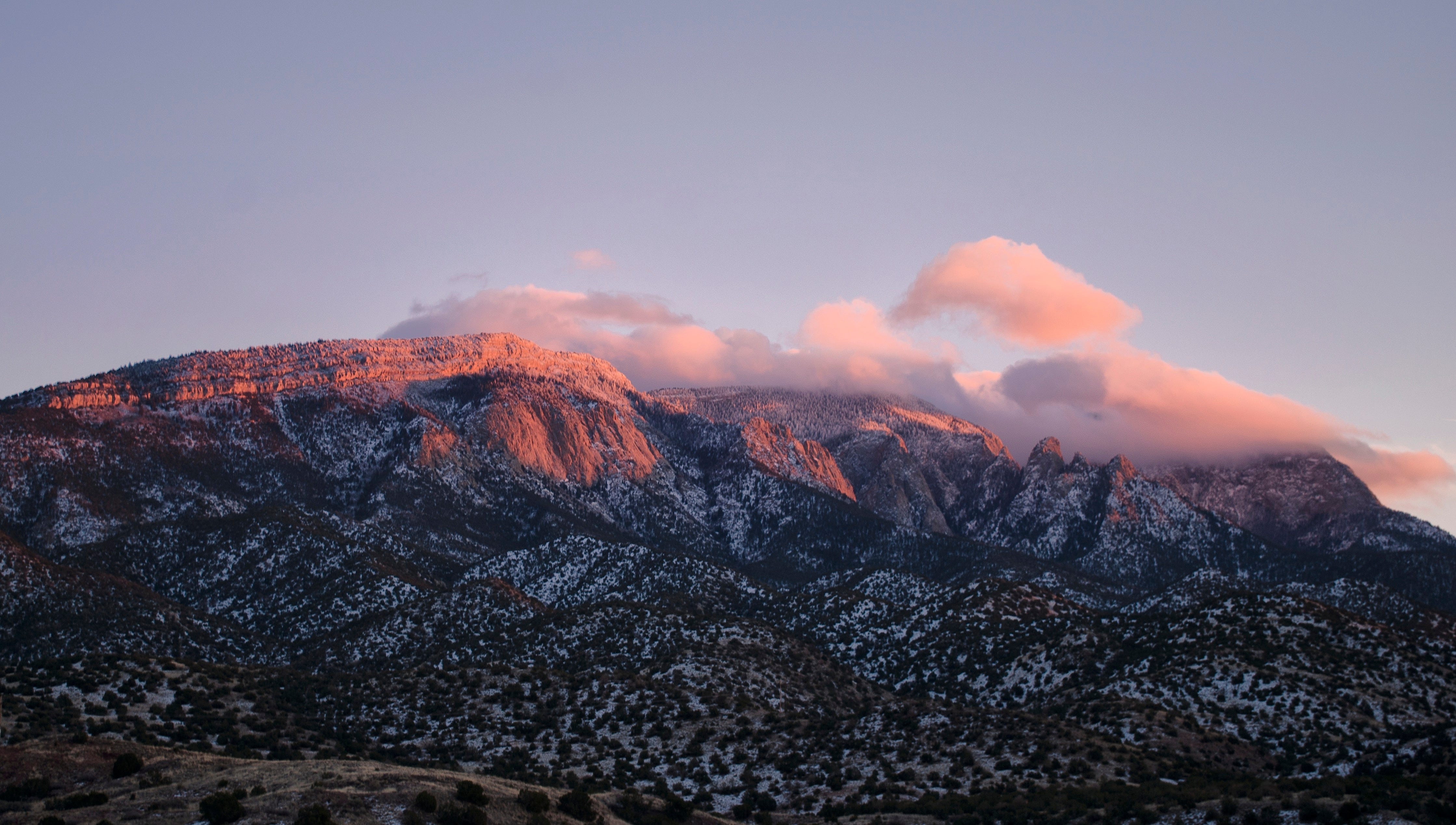
From Albuquerque, the Sandias do not read as scenery. The range comes up off the eastern edge of the city in a single motion, ten thousand six hundred and seventy-eight feet at the crest, and it is visible from the interstate, from subdivisions, from office windows and grocery store parking lots. People orient by it the way people in other cities orient by a river. Roughly two million visits a year land on that mountain, more than half of them arriving by tram or by the scenic byway, and the rest on foot from trailheads that fill by seven in the morning on a Saturday.
I lived under it for years. I climbed the Shield and the granite scattered up the La Luz corridor, hiked and ran that trail through every season, came down it in the dark more times than was advisable, and rode the foothills below it until I knew the dirt by feel. The west face is where I learned what this landscape asks of a person, and what it costs when you misjudge it. I mention this at the outset because the access now being invoked against the Pueblo of Sandia is mine, and I do not accept the terms on which people are defending it.
The Pueblo of Sandia has asked Congress to move roughly 9,890 acres of that west face out of the Forest Service and into trust with the Bureau of Indian Affairs. The land is known as the T’uf Shur Bien Preservation Trust Area, and about three-quarters of it sits inside the Sandia Mountain Wilderness. Stuart Paisano, the Pueblo’s governor, has said Sandia would honor existing trails, roads, utilities and hunting arrangements, and would restrict only what wilderness rules already prohibit, such as off-roading and mountain biking. The Sandoval County Commission endorsed the proposal unanimously in June. New Mexico’s governor, Michelle Lujan Grisham, and Representative Melanie Stansbury have written in support, as has State Land Commissioner Stephanie Garcia Richard, who observed that the transfer would bring the Pueblo’s forestry and wildland management expertise to bear on a landscape that badly needs it.
On July 30, Senator Martin Heinrich said the bill would not be introduced as written. Heinrich is not a marginal figure in this. He is among the Senate’s most reliable defenders of public land, a serious backcountry user himself, and a politician with a genuine record of working with tribal governments, which is what makes his statement worth quoting at length. The federal government, he said, has a responsibility to respect tribal sovereignty and self-determination, to honor the government-to-government relationship, to listen to tribal leaders and take their perspectives seriously, and to recognize that tribal nations have a unique history, culture, and relationship to their homelands. Then, in the next breath: “What I do not support is transferring title away from the Forest Service or eliminating this area’s wilderness protections.” Asked afterward to explain the risk, he pointed out that a future Pueblo council could decide to close the area entirely, as tribal governments are able to do on other tribally controlled land.
The concern, stated plainly, is not that the Pueblo would manage the mountain badly. It is that the Pueblo would manage it at all. And it rests on a premise that anyone who actually uses that mountain should recognize as false, which I will come back to.
Two opposition coalitions have formed since, Sandias for All and the Coalition to #SaveTheSandiaWilderness, and their arguments have moved faster than anyone’s ability to check them. One organizer told a reporter that the transfer would eliminate ninety-nine percent of public access to the area and jeopardize a two-billion-dollar tourism economy. I have not been able to locate any analysis supporting that figure, which does not mean none exists, but does mean an unsourced number is currently doing a great deal of political work in a fight where the details will decide everything.
The acreage did not wander into the national forest by accident, and the current debate has been conducted almost entirely without reference to how it got there.
The Pueblo’s legal claim descends from a Spanish land grant of 1748, and the distinction in that sentence matters. Spain did not give Sandia the mountain. Pueblo people had been living in this stretch of the middle Rio Grande for centuries, and using that range far longer than any European record of it exists; the grant was a colonial administration writing down an occupation it had found already in place. Everything that follows is paperwork trying to catch up to that fact. After the United States acquired the territory, Congress confirmed the grant in 1858 and ordered a survey; the survey was run in 1859, and the patent was issued in 1864. The surveyor set the eastern boundary along a foothill on the mountain’s western slope instead of the main crest, and in doing so left roughly ten thousand acres of a congressionally confirmed grant outside the Pueblo’s title. This is not a tribal allegation about a settler government. In January of 2001, the Interior Department’s own solicitor, John Leshy, concluded that the 1859 survey was erroneous and that a corrected survey would put the boundary at the crest. Had that opinion simply been implemented, the land would have left federal ownership.
What has gone unmentioned in the current fight is what happened when the Pueblo first tried to fix it. Sandia approached Interior in 1983, one hundred and twenty years after the patent. Interior’s solicitor at the time, Ralph Tarr, rejected the claim, and in doing so identified the Pueblo’s long silence as the most troubling circumstantial evidence against it. A century of not complaining read as evidence that nothing much had been taken.
Consider what that century actually contained. By one scholarly account, the population at Sandia fell from two hundred and sixteen people in 1860 to seventy-three in 1910. In 1965, having no other source of income beyond outside wage work, the Pueblo leased land to the Sandia Peak Tram Company. A pueblo of seventy-three people does not file a federal survey challenge; it survives, or it does not, and Sandia did, barely. The United States later weighed that survival against them. There is a mechanism here that nobody in the current argument seems willing to name, which is that dispossession tends to produce the very conditions, depopulation and poverty and legal invisibility, that are subsequently offered as proof the dispossessed were not serious.
Into that gap, in 1978, Congress placed a wilderness.
The Sandia Mountain Wilderness was created by the Endangered American Wilderness Act, and two years later, Congress went back and extended the wilderness’s western exterior boundary, which is to say the exact face now in dispute. At hearings in 2001, a member of the New Mexico delegation would describe the designation as one of the most important legacies he expected to leave. He may well have been right about that. The mountain was under real pressure in the seventies, subdivisions climbing toward the foothills and mining interests circling, and wilderness designation was a defensible answer to a genuine threat.
It was also, as a matter of law, an act of description. The Wilderness Act of 1964 defines wilderness as land “where the earth and its community of life are untrammeled by man, where man himself is a visitor who does not remain.” It is a beautiful sentence, and one of the most consequential in American environmental law, and on the day it was applied to the western face of the Sandia Mountains it was false. It described a landscape with no permanent human relationship, no prior political authority, and nobody who had stayed. There was a pueblo four miles away whose relationship to that mountain long predated the survey that severed it, and whose members had never stopped going up there.
Note also what the 1978 statute was called. Endangered American Wilderness. In the framing that carried the day, the vulnerable party on that mountain was the mountain.
The wilderness designation did not dispossess Sandia Pueblo; a surveyor did that in 1859. What the designation accomplished was to take an error and give it permanence, ecological virtue, a national constituency, and a moral vocabulary. By the time the federal government conceded the line was wrong, the wrong line had acquired millions annual visitors and a legacy.
That vocabulary is now being used to answer the Pueblo. Title must stay federal; wilderness must remain wilderness; access must be guaranteed in perpetuity. The visitor who does not remain has organized, rather effectively, to make his own presence permanent and the Pueblo’s authority provisional.
A necessary clarification, because of the season we are in: handing title to a sovereign tribal government whose claim Congress confirmed in 1858 is not the same act as selling federal land to a state, a developer or a mining company, and I oppose the latter without qualification. That both can be filed under “federal land transfer” is precisely the confusion the word public makes available. On at least one hunting forum the story is already circulating under that heading, with the pointed addition that the recipient here would be, in the poster’s words, one pueblo.
The strongest objection to the Pueblo’s proposal is that Sandia already made this deal, and it deserves a better answer than it has been getting.
Congress passed the T’uf Shur Bien Preservation Trust Area Act in 2003. The land stayed in the national forest and the wilderness system. The Pueblo received unrestricted traditional and cultural access, a role in management, jurisdiction over certain conduct, and the ability to object to new uses; in exchange the statute extinguished its remaining claims and preserved federal ownership, public access, private property and rights-of-way. People have arranged their lives around that settlement for twenty-three years, and reopening negotiated settlements does carry a real cost to the credibility of settlements generally. The Pueblo’s current assurances, moreover, are assurances and not statutory text. Paisano has said the Pueblo would contract with the state Game and Fish department to keep offering hunts through the public draw, and I believe he means it, and a future council could decide otherwise. That is not a slur on tribal government. It is a description of what governments are.
But there is something obtuse about reading that settlement as a bargain struck between equals.
Look at what preceded it. Four decades of litigation. An agency that rejected the claim and cited the Pueblo’s poverty-enforced silence as evidence against it. A federal court that had to vacate that rejection as arbitrary and capricious. A solicitor’s opinion, finally, that the Pueblo was owed the land outright, followed immediately by a negotiated arrangement under which the Pueblo received rights and the United States kept title. And behind that particular sequence, two centuries of the same arithmetic performed over and over by tribal nations across the continent: you take what is on the table, because what is on the table is more than you had yesterday, and because the alternative is another generation of litigation your people may not be around to finish. My own community has done that math. Nearly every tribal nation in this country has a version of it.
Agreements signed under those conditions get called consent, and then get cited back decades later to explain why the tribe should stop asking. A settlement signed to stop the bleeding is not a declaration that the wound was fair.
New Mexico’s conservation organizations have now answered the Sandia question, and their answers are considerably more interesting read in sequence than one at a time.
In April of 2025, in support of permanent protections for the Greater Chaco landscape, New Mexico Wild’s executive director, Mark Allison, called federal action crucial to protecting cultural heritage and sacred sites, many of which lie outside the park’s boundaries. The organization’s release announced that New Mexico Wild stood united with Pueblo leadership in calling on elected officials to safeguard the landscape. In March of this year, the same organization joined an amicus brief in state appellate litigation supporting Sandia Pueblo, arguing that the Pueblo was defending not only its own right to instream flow of the Rio Grande for cultural and traditional purposes but public welfare values benefiting all of New Mexico. In July, on the mountain, its support became conditional on continued federal ownership, continued federal management, preservation of the wilderness designation and legally guaranteed public access in perpetuity, which is support for everything except the transfer.
The New Mexico Wildlife Federation has been more direct, and I give its executive director, Jesse Deubel, credit for that. Deubel acknowledged that Forest Service budget cuts are a genuine national problem, said that this was not a legitimate reason for Congress to move the land out of Forest Service management, and stated that the federation would rather see the agency properly funded and the land kept open to all. The federation has also, in other contexts, warned against policies that undermine the inherent sovereignty of Indian nations, and during the pandemic told its members to respect tribal closure orders without argument.
The word for this is not hypocrisy, which is too easy and would let everyone off. What the record actually shows is a pattern with an internal logic: these organizations treat tribal nations as partners when a tribe is fighting the organization’s opponent, and as stakeholders when a tribe is asking the organization for something. At Chaco, the ask was to stop oil and gas, which costs a conservation group nothing and arrives with moral reinforcement attached. In the water case, the Pueblo’s instream claim ran parallel to the organization’s own river work. At Sandia, the ask is title, and title costs their constituency certainty. The asymmetry is the whole finding. Sovereignty has been, for a decade, a reliable asset. This is the first time it has arrived as a bill.
I do not think Allison or Deubel is acting in bad faith, and I am not writing from outside the room. I have worked with conservation organizations for over a decade, taken their money, shared their stages and helped write their language. Both men run institutions accountable to constituencies with real and legitimate attachments to that mountain, and both are doing what such institutions do. That is why the problem will recur, and why it is worth describing structurally rather than personally.
We have already seen where this reflex goes when it hardens, and the case is one I have a stake in as a climber.
Cave Rock rises above the southeastern shore of Lake Tahoe, and to the Washoe Tribe it is a site of profound religious significance. To climbers it became a destination, with bolted routes installed over years without anyone’s permission. In 2003, after extended consultation, the Forest Service prohibited climbing there while permitting other uses. The Access Fund, the national climbing advocacy organization, sued, its board approving the litigation unanimously. The argument was not merely that the closure was arbitrary. It was that protecting the site violated the Establishment Clause by impermissibly accommodating Washoe religion.
The Ninth Circuit rejected the claim, holding that protecting a culturally significant place does not become unconstitutional because part of its significance is sacred, and noting along the way that climbing was not a legitimate historic use of the site. Had the court gone the other way, federal agencies would have faced constitutional exposure every time they accommodated a tribal sacred-site concern, and the more meaningful the protection, the greater the exposure.
The Access Fund today publishes guidance encouraging climbers to acknowledge that they recreate on Indigenous and sometimes sacred land, and describes land acknowledgments as a way of resisting the erasure produced by removal. I have found no Access Fund position on Sandia, and someone should ask for one, and should also ask whether the organization still stands behind what it argued at Tahoe.
The deeper problem Cave Rock reveals is what federal ownership actually protects. In Lyng v. Northwest Indian Cemetery Protective Association, the Supreme Court permitted the Forest Service to proceed with a road project even though the government’s own study found it could devastate the religious practices of the Yurok, Karuk and Tolowa peoples; the government, the Court reasoned, was managing its own land. Cave Rock is the mirror image, an agency that did protect a sacred place and was sued for accommodating too much. Taken together the two cases describe an arrangement in which tribal nations may be unable to prevent desecration on federal land, and may be sued by recreational users when an agency prevents it on their behalf. The sacred, under federal title, is a value the agency may weigh and may discard, and the tribe’s recourse is to ask again. Sandia has now been asking for forty-three years.
Meanwhile the practical case has been quietly won, and almost nobody has noticed. Paisano told county commissioners that the Cibola National Forest has no dedicated law enforcement rangers and depends on officers assigned to multiple projects, while the Pueblo maintains a twenty-six-member state-certified police force and a new fire station equipped for wildland response. The Pueblo already manages more than sixteen thousand acres of forest in the Carson National Forest area. It has said it would restrict only what wilderness rules already forbid.
That last point is worth sitting with, because it locates the actual disagreement. The objection is not to restriction; wilderness is a restriction regime, and that is the entire purpose of the designation. The objection is to who issues the restriction. Rules that exclude mountain bikers are protection when the Forest Service writes them and a threat to access when a Pueblo government would.
Which brings me back to the premise underneath all of this, the fear that a future council might close the mountain. The Forest Service closes the Sandias routinely. It closes them for fire restrictions, for hazard trees, for construction, for wildlife. Peregrine falcons nest on the west face, and cliffs across the Cibola go under raptor closures beginning March 1 in a normal year. The Shield itself, one of the formations I climbed, was closed to climbing by the Forest Service from 2017 until 2019 to protect nesting peregrines, and no coalition formed, and no one described it as the elimination of public access, because the agency issuing the order enjoys a presumption of legitimacy that a tribal government does not.
As I write this, the Forest Service has closed one hundred and forty acres at the top of the mountain, along with the Crest Road and every parking area above the ten-thousand-foot lot, for a fuel reduction project and the demolition of the crest house. That order runs from April 30 of this year through the middle of January 2027. It shut the most heavily used access point on the range for the better part of nine months. It was announced through an alerts page. Nobody voted on it, nobody with a permit or a plan had recourse, and the people currently warning that the Pueblo might someday restrict access are, at this moment, driving around a federal closure to reach the trailheads where they say so.
Federal ownership has never guaranteed access. It has only guaranteed that the party closing the gate would be an agency, and that its decisions would be received as management rather than as loss.
And the mountain that all this vocabulary is protecting is being ground down by the people invoking it. I watched it happen over years: unofficial trails braiding across slopes that had no trail on them a few seasons earlier, trash at the trailheads and well above them, graffiti on good rock, fire rings where no fire belongs, hardware appearing on routes without anyone asking anyone, use exploding after the pandemic with nothing added to absorb it and no ranger presence to speak of, because there was no ranger. Everyone who spends real time up there knows this. What is not being said out loud is that the Pueblo is describing those conditions accurately, and that the constituency most alarmed about losing access is, in aggregate, the constituency producing them. I was one of the two million.
There is one more thing about the origins of the claim that the current fight has managed to lose entirely. A Sandia elder, speaking at a public forum during the settlement negotiations, said the land claim had grown out of the 1980s, when mining requests started coming to the Pueblo and the elders said that if we start punching holes, we are going to destroy our mountain. The claim’s origin story is conservation. It has taken forty-three years for conservation organizations to be asked to notice.
Sandia will not be the last of these, which is the reason to be clear now rather than later.
Other nations will seek the return of land, or jurisdiction, or final authority over places currently administered by agencies. Some will manage in ways conservation organizations admire and will make excellent partners. Others will put housing, public safety, economic development or cultural privacy ahead of the preferences of environmental groups, which is a thing governments do, and which is not a reason to withhold recognition from them. Sandia Pueblo should not have to demonstrate that it will govern better than the Forest Service before its claim to authority is taken seriously; no state is asked to prove flawless ecological performance as a condition of its legitimacy, and the federal government has clear-cut forests, dammed rivers, permitted mines and damaged sacred places without ever forfeiting the presumption that it is entitled to govern. Sovereignty is not a prize awarded to Native governments that perform the environmental values of outsiders.
So the question every organization watching this should answer, before the next one arrives, is not whether it supports tribal sovereignty in the abstract. It is whether that support survives contact with title, with jurisdiction, and with a tribal government’s authority to say no to hunting, or climbing, or wandering off the trail. And there is a narrower question that has not been asked in print and could be answered this week: would you support a transfer that had a tribal wilderness designation? If wilderness status is the real sticking point rather than tribal ownership, that is a legitimate position, and it should be said on the record where it can be negotiated.
For now the answers on offer are these. Heinrich supports co-stewardship but not transfer of title. New Mexico Wild respects tribal sovereignty and requires permanent federal ownership. The Wildlife Federation wants the land open to all. Each of those positions draws a boundary around tribal authority, with consultation and cultural access and partnership and joint campaigns on one side of it, and ownership and the power to inconvenience their own constituencies on the other.
None of which means nothing has changed. A great deal has, and many of the people inside those institutions are working in good faith to build something better than what they inherited. But every institutional transformation eventually reaches the place where language stops being sufficient, and for conservation that place is visible from the interstate, on the western face of a mountain that was confirmed to a pueblo by Congress in 1858 and taken from it by a surveyor the following year.
The question is no longer whether conservation organizations can acknowledge that relationship. It is what they are willing to give up because of it.
Sources
Heinrich statement and interview: Pat Davis, New Mexico Political Report / The Paper., July 30, 2026 — https://nmpoliticalreport.com/2026/07/30/heinrich-working-for-bill-to-share-sandia-mountains-management-with-sandia-pueblo-short-of-pueblos-ask-for-total-control/
Sandoval County vote, opposition coalitions, Pueblo law enforcement and fire capacity: Jesse Jones, The Paper., July 23, 2026 — https://nmpoliticalreport.com/2026/07/23/sandoval-county-backed-a-sandia-mountain-land-transfer-now-critics-want-it-stopped/
Lujan Grisham, Stansbury and Garcia Richard support; Deubel statement; public draw hunting: New Mexico Wildlife Federation — https://www.nmwildlife.org/news/sandia-pueblo-seeks-to-expand-reservation-to-10k-acres-of-forest-service-land-on-east-side-of-sandias-gov-and-other-officials-approve
Paisano on vandalism and Forest Service capacity: KOB 4 and KRQE, July 2026
Recreation reaction and 2003 Act text: Santa Fe New Mexican, July 29, 2026 — https://www.santafenewmexican.com/news/local_news/sandia-pueblos-bid-to-transfer-10-000-acres-away-from-forest-service-alarming-outdoor-enthusiasts/
Survey history, Tarr opinion, 1994 litigation, Leshy opinion: Joint hearing on S. 2018, 107th Congress — https://www.govinfo.gov/content/pkg/CHRG-107shrg80581/html/CHRG-107shrg80581.htm
1980 western boundary extension: Public Law 96-248 — https://www.govinfo.gov/content/pkg/STATUTE-94/pdf/STATUTE-94-Pg355.pdf
Population decline, 1965 tram lease, unofficial trails: Berthier, “Sandia’s ‘new buffalo’ ideology,” American Indian Workshop — https://www.american-indian-workshop.org/AIW26/papers/Berthier.pdf
Elder statement on mining and the origins of the claim: ICT archive — https://ictnews.org/archive/sandia-pueblo-land-claim-progresses/
New Mexico Wild on Chaco: April 10, 2025 — https://www.nmwild.org/2025/04/10/new-mexicans-applaud-the-reintroduction-of-legislation-to-protect-public-lands-surrounding-chaco-canyon/
New Mexico Wild amicus brief supporting Sandia Pueblo: NMELC, March 2026 — https://nmelc.org/wp-content/uploads/2026/03/NMELC-NM-WILD-Motion-to-File-and-Amicus-Curiae-Brief-Supporting-Sandia-Pueblo.pdf
Current Sandia Crest area closure order 03-03-05-26-02 (April 30, 2026–January 15, 2027), fuel reduction and crest house project: Cibola National Forest alerts — https://www.fs.usda.gov/r03/cibola/alerts
Shield peregrine closure 2017–2019 and annual March 1 raptor closures, Juan Tabo Canyon: Mountain Project — https://www.mountainproject.com/area/106355416/juan-tabo-canyon
Cave Rock: Access Fund v. USDA, 9th Cir. 2007
Lyng v. Northwest Indian Cemetery Protective Association, 485 U.S. 439 (1988)
Great piece. I'm reminded of the quote from the latest Odysseus, "The power of a sacrifice is in the cost to the person making it." I've been a part of weighing similar issues when coalitions we've been a part of are confronted with supporting Tribal water rights, even when some Tribes may want to (god-forbid!) use the water, not just leave all of it in the river for conservation purposes. I've also been reading about the history of the Havasupai and their struggles with federal land maneuvers that eventually led to Grand Canyon National Park and connected Forest Service areas. Combined it all makes me think that both federal land management and conservation groups could use a long-needed reorientation around humanity as an inextricable part of the land. Of course, many Native people and nations have lived this reality for centuries, but if there is to be a shift in how we "do conservation" in our country, I wonder if this is the essential cultural shift that must accompany it.
Thank you for illuminating this. I'm moving to Albuquerque next year and had read about the Sandia closure but not a rigorous history and analysis like this. Hope you are graced with more time to pursue writing projects.